Memories
How ACE 2.0 handles memories
Written By Will (F&F Dev)
Last updated About 1 year ago
Memories are an important aspect of Friends & Fables to maintain long term campaign coherence. ACE will create memories every 5 turns which encode important information that recently happened such as key characters and plot details in a compressed format. These memories can be searched for and brought into Working Context when deemed appropriate, and combined with the Current Plot form the historical information used by the AI.
Viewing Memories

If the AI decided to record a memory for a message, you can see them by clicking on the memories on the bottom of the message. You can also view all the memories in your campaign by clicking on the memories tab in the side bar:
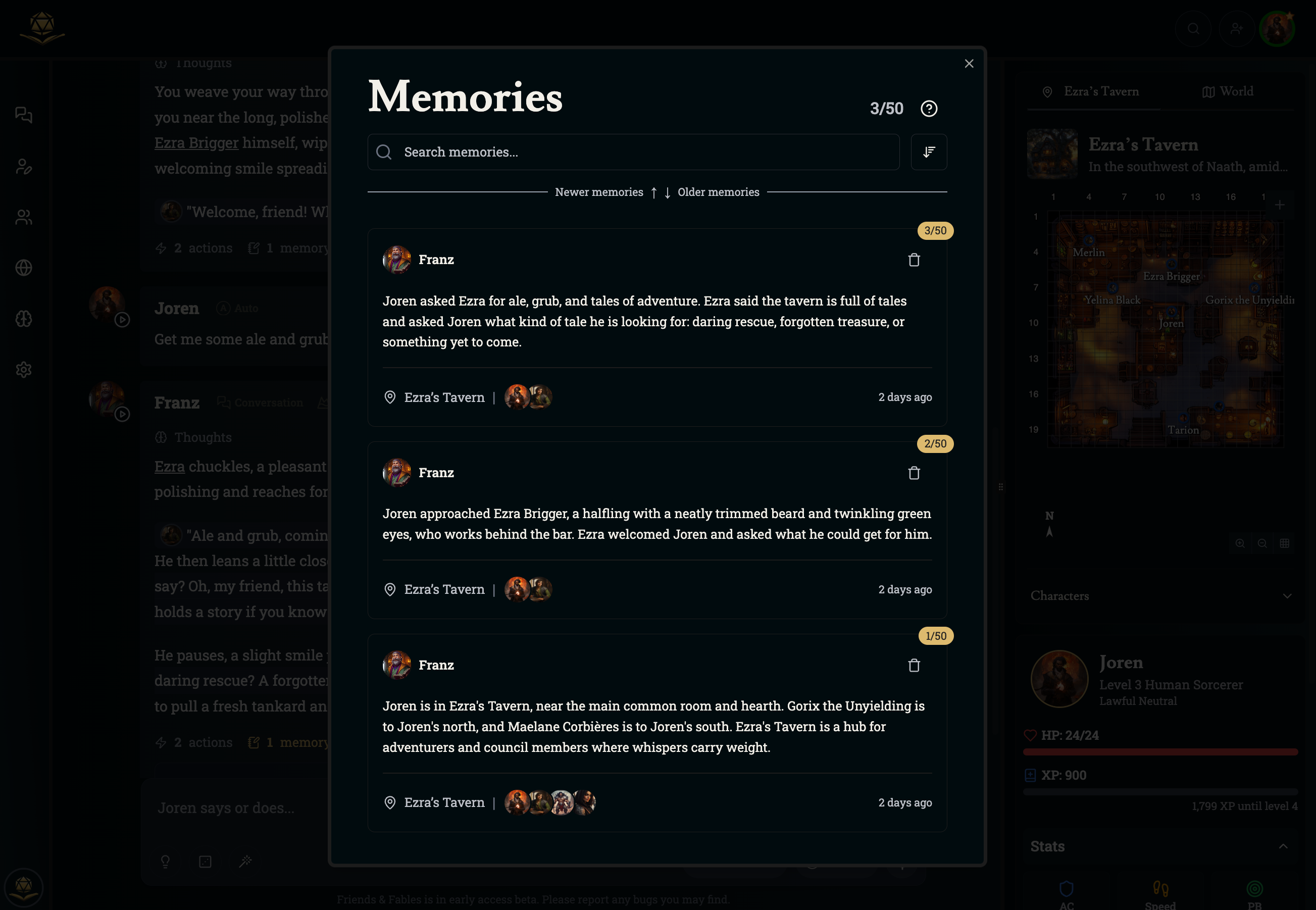
On each memory, you can also see the Point of Interest the memory occurred at and the related characters involved with the memory. ACE is able to use the location and characters attached to memories to pull in relevant memories for a location or character when needed.
Ensuring Memories are in Context
For each response, ACE will conduct research and pull in relevant memories when appropriate. Searching and bringing in relevant memories is not always an easy task, so the AI may not be able to always retrieve the memories that a player thinks are most important. To ensure a memory is in context for the AI, you can add it to the Working Context as a memory block either manually or through the memory dropdown menu.

FAQ
Why don’t you include all the memories all the time?
The amount of memories included in context are limited for primarily two reasons:
Costs and speed: Having every memory that ever happened in a campaign in context all the time is not practical as the costs for all the tokens quickly balloon out of control, and having more information to parse through also significantly slows down the AI responses.
Performance: Even if cost and speed were not an issue, having all the memories in context all the time does not lead to better results, and often worsens it. This is very similar to how we operate as humans — when focused on a task at hand, we only have the relevant information and memories we need to complete the task loaded in our brains. Having all the memories that ever happened in our lives loaded all the time would be wasteful and make it harder to concentrate on what’s important, as 99% of our memories are not relevant. The best results come from having the minimum amount of highly relevant and information dense context for any given task.
Was this helpful?